

The market has spoken: less sugar wins. Consumers scan labels, compare nutrition facts, and increasingly reach for products promising ‘reduced sugar’ or ‘no added sugar.’ But then they taste it. Maybe there’s a metallic twang, or a chemical finish, or it just doesn’t feel right in their mouth. The product goes to the back of the pantry, and the customer stays wondering why food companies can’t seem to get this right. The truth?
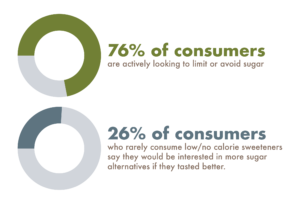
The food industry is stuck in a difficult crossroads: most consumers want to cut back on sugar, yet a significant share won’t choose current low- and no-calorie sweeteners because they simply don’t taste good enough. In other words, demand for lower sugar is rising—but the available solutions aren’t meeting sensory expectations. This gap between consumer desire and acceptable solutions represents both a massive challenge and an extraordinary opportunity for food and beverage R&D teams.
This opportunity isn’t just theoretical. It’s financial. The global sugar-free food market is projected to grow to over $83 billion by 2034, driven by consumers who think that reducing sugar intake can improve their overall diet quality and help prevent future health conditions, or help maintain them for people with conditions like diabetes.
The Sugar Reduction Problem Is Bigger Than Sweetness
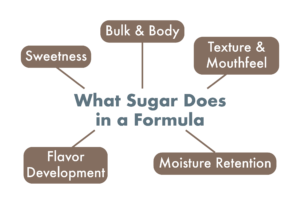
 For food developers, sugar reduction is never just about ensuring sweetness. Sugar is a structural ingredient that plays multiple roles at once:
- Sweetness
- Bulk and body
- Texture and mouthfeel
- Moisture retention and shelf life
- Browning and flavor development
Remove sugar, and you don’t remove one function—you remove five. Most alternative sweeteners address only one or two of these issues.
 This isn’t just about taste. It’s about the fundamental challenge of replacing a key, multifunctional ingredient with alternatives that do only one thing and don’t even do it as well as sugar. Sugar-reduced and sugar-free recipe adjustments can require a swap from one ingredient to three. Each missing function is to be replaced separately, often with gums, bulking agents, and stabilizers. The result is longer labels, higher formulation complexity, and products that often still fall short of consumer expectations.
Still, taste remains the biggest challenge. As you replace more sugar, sweetness tends to peak quickly and linger unpleasantly. Consumers can experience bitterness, metallic notes, cooling sensations, or a sweetness that feels artificial. Even when sweetness intensity is correct, the overall flavor might still be wrong.
Voluntary sugar‑reduction efforts show just how challenging meaningful reformulation can be. For example, in the UK, years of public health campaigns and voluntary reformulation targets led to only marginal reductions in sugar—3.5%. Brands understood the concerns around high sugar content and recognized growing consumer demand, but they were reluctant to make changes that might compromise taste, texture, or brand loyalty. Without a compelling reason to take that risk, most product lines stayed largely the same.
The UK Soft Drinks Industry Levy created a turning point: average sugar levels in taxed beverages dropped by nearly 50%, with manufacturers responsible for roughly 80% of the reduction through reformulation rather than shifts in consumer behavior. The difference wasn’t awareness or intent—it was feasibility. Reducing sugar requires research, development, investment, and time. When reformulation became unavoidable, companies were forced to invest in finding sweetening solutions that could remove large amounts of sugar without compromising sensory quality. The contrast makes one thing clear: sugar reduction didn’t stall because companies didn’t care, but because the work it takes to effectively do so is time-consuming and costly.
A New Approach
Zukora™ Honey Truffle Sweet Protein is a fresh take on sweetness. While it’s not a stand-alone replacement for sugar, it’s a powerful tool within the modern sweetener landscape. Zukora™ Honey Truffle Sweet Protein is a high-intensity sweetener created by isolating the protein responsible for the honey truffle’s sweetness and reproducing it through advanced fermentation technology. Rather than attempting to use it as a 1:1 replacement for sugar, Zukora™ Honey Truffle Sweet Protein is best used in tandem with other sweeteners like stevia, where it’s able to complement and improve overall sweetness perception with low-sugar products. In blended systems, it rounds out sharp sweetness perception, reduces bitterness and lingering off-notes, and helps sweetness feel more continuous and sugar-like—even at very low usage levels.
What That Means for Taste
These sensory benefits are rooted in how Honey Truffle Sweet Protein interacts with the human sweet taste receptor. A 2026 study published in Biochemistry showed that sweet proteins activate the T1R2/R3 receptor through a mechanism fundamentally different from sugar and many high-intensity sweeteners.
Instead of binding to a single site, the protein engages the receptor through a multi-point, allosteric interaction with its structure. This “pinching” mechanism spreads activation across both receptor subunits, changing how the perception of sweetness is triggered.
For formulators, this translates into a couple of key advantages:
- Higher potency: Because so little is required, you minimize the introduction of off-notes into your formula.
- Longer-lasting perception: The receptor remains gently activated, reducing rapid drop-off.
In practice, these properties make Honey Truffle Sweet Protein a natural partner to stevia and other sweeteners. Rather than replacing them, it helps them perform better—improving balance, reducing sensory compromises, and bringing reduced-sugar products closer to the experience consumers expect and want from sugar.
Where Honey Truffle Sweet Protein Fits In
 Some sweeteners perform well in isolated tests but don’t always perform within full formulations. Honey Truffle Sweet Protein has shown versatility across a wide range of applications aligned with major industry trends, including the categories listed below.
- Sports Nutrition Powders
- Powdered supplements
- Protein shakes
- Chocolate & chocolate beverages
- Sauces & dressings
- Powdered Soft Drinks
- Chewing Gum
Why This Changes the Business Equation
The commercial implications are as important as the sensory ones.
Consumers are ready, but only if taste delivers.
A large share of consumers actively want lower-sugar products but reject current alternatives because of taste. Products that genuinely solve this problem don’t need heavy education or persuasion. When they taste good, they sell.
Regulatory pressure isn’t slowing down.
As sugar taxes expand across more than 100 countries and thresholds become stricter, products with high sugar levels are becoming harder to justify. Reformulating now is a strategic way to future‑proof formulations against shifting standards.
It stands out in crowded categories.
Sugar reduction without sensory compromise is a rare advantage—and one consumers notice. Peer‑reviewed safety research strengthens confidence throughout development and commercialization.
Faster, Lower-Risk Development
Because honey truffle sweet protein is effective at extremely low concentrations and backed by mechanistic and sensory understanding, it reduces the trial-and-error cycle that often plagues sugar-reduction projects. Fewer iterations mean faster launches and lower development costs.
Practical Guidance for Food Developers
While highly potent, Honey Truffle Sweet Protein is straightforward to work with when used deliberately:
- Start low and scale carefully—small dosage changes have large effects
- Separate sweetness from structure—don’t expect it to replace sugar’s bulk
- Test temporal perception—its longer sweetness can be an advantage, but application-specific tuning matters
- Validate in-matrix—as with any ingredient, real formulations matter more than lab models
Honey Truffle Sweet Protein rewards precision. Treat it as a high-impact sweetening tool, not a sugar substitute, and formulate with intention. When used strategically, it delivers clean sweetness that performs well with other problem-solving ingredients.
Conclusion
For decades, sugar reduction has forced difficult choices. Taste or health. Performance or clean labels. Consumer acceptance or regulatory compliance. The industry has been stuck choosing which compromise to make, while consumers walked away from products that couldn’t deliver on all fronts.
That era is over.
Honey Truffle Sweet Protein doesn’t ask you to choose between taste and function—it delivers both. With sweetness potency up to 2,500x that of sucrose, it can replace up to 216 teaspoons of sugar (depending on the application) per gram, unlocking formulation possibilities that weren’t accessible before.
Recent breakthroughs in sweet taste receptor mapping revealed the precise structure of human sweet taste receptor cells—the cells on our tongue, palate, and throat that send sweetness signals to the brain. Now, researchers can perform in silico docking simulations to understand how sweeteners bind to these receptors.
The results? Honey Truffle Sweet Protein binds at the T1R2/R3 receptor regions with exceptional efficiency. In vitro receptor assays confirmed what the models predicted: Honey Truffle Sweet Protein is more potent than other leading sweet proteins. These findings were recently published in the Journal of Biochemistry.
These aren’t incremental improvements—they’re fundamental advantages that change what’s possible in sugar reduction.
 The commercial case is equally clear. An $83 billion sugar-free food market is growing at 6% annually, driven by consumers who want products that taste better. Mandatory sugar taxes now exist in 116 countries and counting. Voluntary reformulation programs have failed, achieving just 3.5% reduction. But mandatory programs, forcing genuine innovation, have achieved 47% reduction. The regulatory environment will only intensify.
Your competitors face the same pressures you do. The difference will be who solves the sweetness problem first—and who’s still explaining why their “reduced sugar” products don’t taste quite right.
When one manufacturer launched a genuinely delicious no-added-sugar pasta sauce, retailers couldn’t keep it on shelves. That’s not because consumers lowered their standards. It’s because someone finally delivered what they’ve been asking for all along.
The sensory and safety science is published. The pathway is proven. The market is waiting.